
The sixth principle from the Agile Manifesto is,
“The most efficient and effective method of conveying information to and within a development team is face-to-face conversation.”
Scott Ambler and Alistair Cockburn’s graphic contrasting the efficiency and effectiveness of different communications channels really hits this principle home.
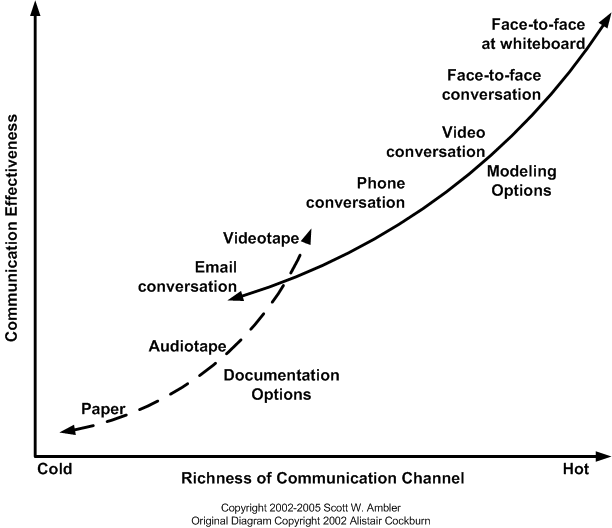
When the Covid pandemic hit in 2020, face-to-face conversation came to a screeching halt. At the time, I thought that the end of face-to-face conversations also meant the end of Agile ways of working. After all, Agile ways of working were premised on the physical proximity of individuals, their interactions and their low-tech paper based tools. Enforced social distancing put an end to all that. What would it mean for Agile advocates?
Fast forward 4 years and the adaptive nature of Agile has spawned a host of innovations and technology advancements that have literally saved Agile ways of working. Necessity was once again the mother of invention! These innovations and technology advancements included:
- Increased network infrastructure capacity and resiliency within our organizations
- The explosive growth of video conferencing platforms like Zoom and MS-Teams
- A proliferation of digital collaboration platforms like Miro and Mural
- The rise of a “Remote First” mindset and approach to group meetings
- Team norms that included agreements on remote, in-person and hybrid work arrangements
All of this has enabled Agile ways of working to continue if not thriving, then at least surviving. In other ways, it’s enabling “Anyone, Anywhere” access to the global marketplace of talent. It’s also generated some real cost avoidance and cost savings benefits. These include:
- Avoiding the growing cost of physical office space
- Workers saving on commute costs which translates into higher daily productivity
- Avoiding the environmental costs of the increasing carbon footprint of in-person business activities requiring travel
- More options for work-life balance leading to reduced costs of personal wellness
- Access to a global marketplace of talent
So, with all these opportunity and cost benefits associated with remote work, is remote collaboration really “cheaper” than in-person, in-the-office work?
This question was prompted by a recent debate at a client trying to decide on whether to hold planning events in-person, remote or hybrid. The high costs of hosting in-person events was the driving factor for the debate. Most people agreed that ideally the planning events would be most effective if either everyone was participating in-person or everyone was participating remote. And, least effective if the participation was a hybrid of in-person and remote. But, is all remote just as effective as all in-person? And, wouldn’t the cost of an all remote event be cheaper?
On the surface, the answer would appear to be “Yes”. Remote events mean no travel costs. However, dig a little deeper into the heart of agile – the people and their interactions and I would argue the answer is “Not always”. The actual answer will depend on what state the people and their interactions are in. Short-term savings on travel costs may mask the higher long-term costs of remote team building and alignment.
The following table considers different people and interaction scenarios. The answer to the question “Is remote cheaper?” isn’t always a clear yes or no.
| Is remote cheaper? | Age of team? | Degree of creativity and innovation in the organization? | Degree of trust in the organization? | Degree of alignment between teams? |
| Yes | Old | High | High | High |
| No | New | Low | Low | Low |
| ? | Old | Low | Low | Low |
| ? | Old | High | Low | High |
| ? | New | High | High | Low |
With new teams, a moment meeting in-person face-to-face will reduce the cost of getting past the storming phase in gelling a team.
A lack of creativity and innovation within an organization can lead to costly loss of business and market share. Nothing sparks creativity more than chance encounters between diverse organizational populations in a co-located space. Often next to a water-cooler or in the company kitchen.
If there are a high number of dependencies between teams, negotiating and securing those dependencies will have a higher likelihood of success if done in person. You can read a person’s body language and pivot your negotiating stance accordingly. It’s also much harder to say “No” to someone’s real face. And it’s easier to look and feel for mutually acceptable middle ground without the constraints of an online meeting time-box.
If you were to raise and negotiate these dependencies remotely, how many virtual meetings and over what period of time do you think it would take to secure and align all stakeholders on all of them? It would feel like herding cats and bees.
Let’s do the math. Having people meet face-to-face for a 2-day event every quarter amounts to ~3.2% of their annual work time. Assuming most people spend at least 1 day a week clarifying goals and chasing dependencies, that would amount to ~20% of their annual work time. Would it be worth your while to realize an almost 17% increase in productivity by spending just 2 days together every 3 months?
Digital interactions feel one-dimensional and fall flat when it comes to building trust. Meeting a real person and taking the time to experience their whole self engenders trust much more. Their wholeness as a person including the firmness of their handshake, the warmth of a hug or deeper personal connections in a social setting.
Remote virtual collaboration tools and infrastructure have come a long way over the course of the pandemic. It’s made the experience tolerable and even fun. However, I still love the low-tech feel of Sharpies, paper Post-its on a physical board, and topped off with lots of paper flip-charts, colour markers and tape.
Every now and then, it’s refreshing and worthwhile to come out of our virtual caves for a breath of reality.

 Next Chapter Consulting