
In the face of declining market demand for agile coaches and scrum masters, one question being asked explicitly or implicitly by some organizations is,
“What’s more important, ensuring delivery of what people have committed to or growing the maturity of the people to deliver?”
High performing agile leaders rely on high performing agile teams to deliver on commitments. Achieving high performance in leadership and teamwork requires guidance, support and … time.
Time to develop and mature new mindsets and new ways of working. Time taken away from delivering on existing commitments.
No wonder it often feels like productivity and delivery slows down for a while before it can speed up – the ‘J’ curve in action.
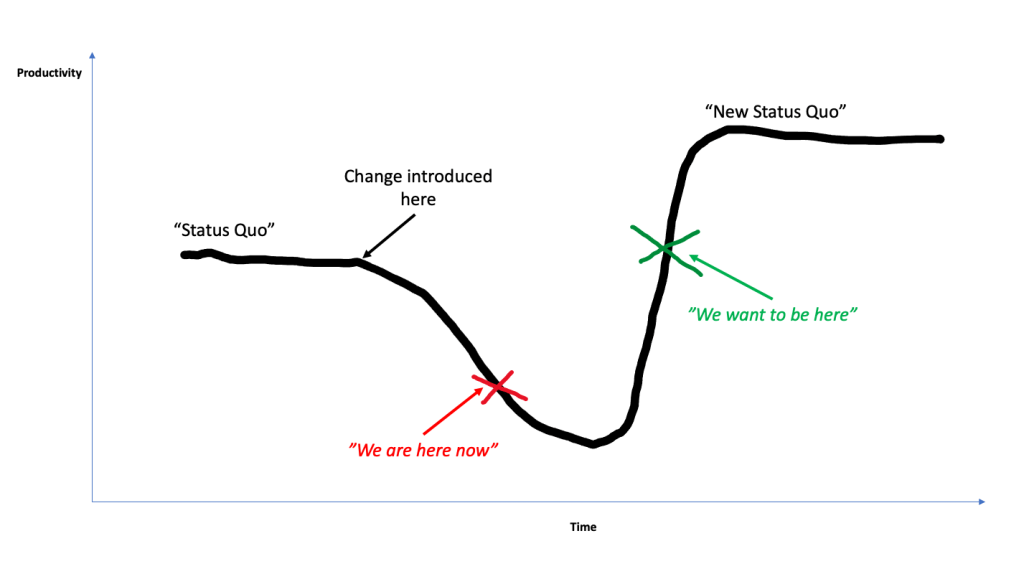
The depth to which productivity dips to, at the bottom of the ‘J’ curve before it starts to improve can be reduced in two ways:
- Increase investment in maturing the leadership’s and teams’ new mindsets and ways of working. This could include adding more Agile coaching support.
- Increase investment in pushing and delivering the old way faster. This could include adding more Project or Delivery management support.
What might each way look like? What are the considerations, implications and consequences for each?
Investing in Maturity would look like this:
- A focus on where we want to be on the ‘J’ curve
- The faith and patience of senior leaders with new ways of thinking and working remain strong and steadfast
- FAIL = First Attempt In Learning
- A willingness to renegotiate existing commitments in the short term
- Introducing and scaling the new ways globally across the organization
- Higher levels of organizational performance, productivity and satisfaction in the long term
Investing in Delivery would look like this:
- A myopic focus on where we currently are on the ‘J’ curve
- Leadership is losing faith and patience with new ways of thinking and working. Productivity continues to decline as adoption of the new ways is taking longer than expected
- Staunch advocates of the old ways begin to murmur resistance and a slide back to the old status quo – their old comfort zone
- Failure is unacceptable and feared. Success = at all costs
- Change is fine but we can’t slow down on our commitments.
- Maintaining local levels of performance, productivity and satisfaction in the short term
The decision boils down fundamentally to a choice between:
- Growing capability for the future or
- Sustaining delivery in the present
The former will benefit from doubling down on agile coaching support like Agile Coaches and Scrum Masters. To teach, mentor and enable people on how to improve and be continuously better in the future.
The latter depends and relies on project management types like delivery leads and Release Train Engineers (RTEs) who can tell people what to do and when to do it. To ensure failure is not an option by pushing harder to accelerate delivery of commitments at any cost.
There are many potential reasons for the recent lack of market demand for agile coaching support. Some of the reasons include,
- Agile ways of thinking and doing are fully entrenched in the DNA of the organization and its people. It’s become the new status quo to continually seek out the next status quo
- Agile ways of doing are standardized in a playbook and practiced mindlessly everywhere in the organization. Victory has been declared for the transformation. Operating budgets have no line items for agile coaching. Time to reap the rewards of the transformation to focus 100% on delivery.
- Agile ways have failed to take hold. The experiment is over. The return to the comfort of the old ways is welcomed. Enough time spent on people. Time to get back to focusing on process and delivering product.
It would be too simplistic to think that the recent lack of demand for agile coaching support is solely due to any one reason such as deciding on delivery over maturity.
The decision doesn’t have to be ‘EITHER’ one ‘OR’ the other.
And, maybe the market demand would be better stimulated, served and sustainable if we, as agile practitioners were to focus on enabling ‘BOTH’ maturity ‘AND’ delivery at the same time.
Maturity without delivery leads to unproven potential.
Delivery without maturity leads to a lack of adaptability.
Focusing on both in small amounts will help to address the needs of both the present and the future.

 Next Chapter Consulting