
How do you see your job?
- As a means to an end? Something you do to put food on the table and to make a living?
- As an end in itself? Something you do to develop and grow yourself?
- Both 1 and 2?
How you see your job is a good indicator of how satisfied you are with your job.
- If you answered 1, your job satisfaction is probably low, and you’d jump at the chance to change jobs.
- If you answered 2, your job satisfaction is probably high, and you’d have no qualms doing more than necessary or going above and beyond what the job requires.
- If you answered 3, your job satisfaction is probably somewhere in between.
If you’re like me and many of the people I work with in organizations, then you would’ve answered 2 or 3.
If you did, how’s that working out for you?
In theory, one of the benefits of being an employee of an organization is the organization’s commitment of time and resources to develop yourself professionally and personally. Like the old adage, “It’s not a job, it’s a career”, it’s the reason many people prefer being an employee over being a contract worker.
On the other hand, contract workers have zero expectations or commitment for personal or professional development from the organization. Contract workers are hired guns who should already be proficient in the job they were hired to do. No organization would pay a contractor to develop the skills needed to do the job as described in job posting.
For employees, there is a two way expectation for personal development and growth.
- The employee expects the organization to actively support their desire to develop their capabilities by granting them time and funding to take courses or training (eg. Up to 10 training days per year) and by opening up opportunities to move from one job to another within the organization.
- The organization expects employees to develop themselves so that their contributions increase and have greater organizational impact over time.
Great in theory, however what I’ve seen is a tendency in both the employees and the organization to prioritize short term work-related commitments over longer term employee capability building.
There just never seems to be any time for courses or training. There’s always a work deadline to meet.
As a former technology manager, I was constantly balancing between my responsibilities
1. To get the technical work done.
and
2. To nurture the growth of my staff’s capabilities.
During my early management career at IBM, an experiment was conducted to see what would happen if the technical and people management responsibilities were no longer combined in a single manager but split between two managers:
- A technical manager who had technology delivery responsibilities only with no people or HR responsibilities.
- A people manager who had people development and performance management responsibilities only with no delivery responsibilities.
They even assigned colours for each of the management types:
- The Technical only managers were “Green” managers.
- The People only managers were “Blue” managers.
The motivation for this experiment was partially driven by IBM’s basic belief of “Respect for the individual”, the first of IBM’s Three Basic Beliefs. By dedicating a manager to focus only on HR tasks like professional development, salary administration and hiring, the expectation was that employees would benefit from the dedicated attention to their personal welfare unencumbered by other management accountabilities.
However, the most poignant memory I have of that IBM experiment was how disappointed and frustrated the Blue managers were with their limited role focused only on HR responsibilities.
Needless to say, the concept of Green and Blue managers did not survive beyond that initial experiment.
Looking back on that IBM experiment, the role of Blue managers felt like a pre-cursor to the role of “Chapter Leads” within the Spotify Model’s “Chapters” organizational structure.
In the Spotify Model circa 2012,
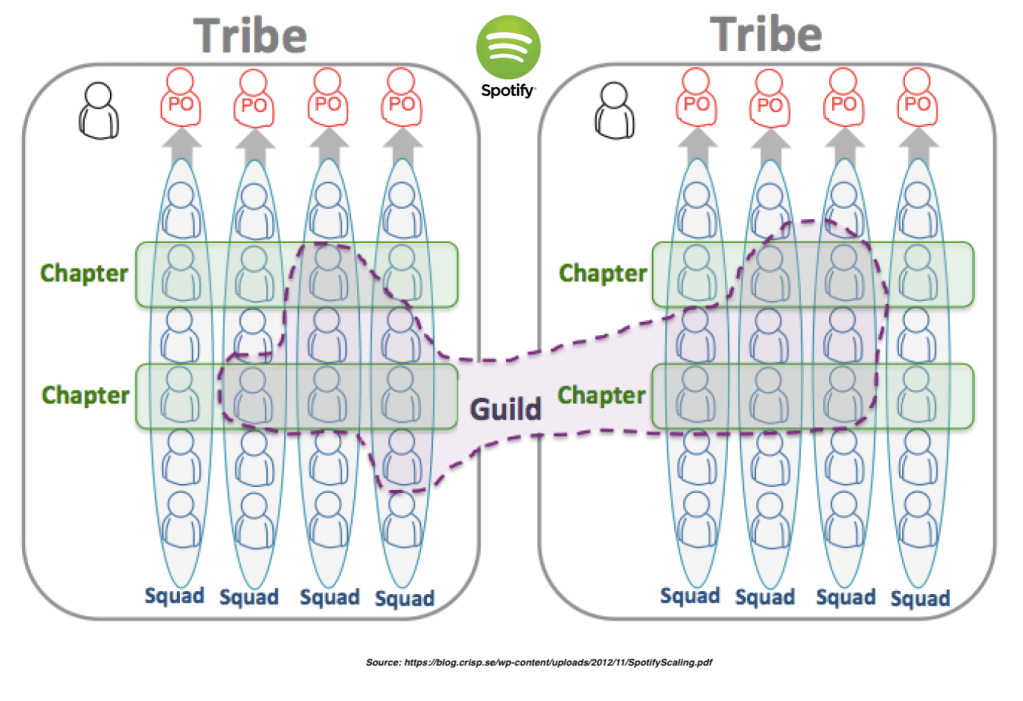
- The chapter is your small family of people having similar skills and working within the same general competency area, within the same tribe.
- Each chapter meets regularly to discuss their area of expertise and their specific challenges - for example the testing chapter, the web developer chapter or the backend chapter.
- The chapter lead is line manager for his chapter members, with all the traditional responsibilities such as developing people, setting salaries, etc.
- However, the chapter lead is also part of a squad and is involved in the day-to-day work, which helps him stay in touch with reality.
Judging by the success of Spotify at the time it was using their model and by the proliferation of Spotify Model copycats in the industry since that time, I would say Spotify had much more success with Chapter Leads and Chapters than IBM did with its short-lived Green and Blue managers.
As an Agile Coach, I’ve had the opportunity to engage directly in two Chapter implementations based on the Spotify Model:
- As part of an Agile consultancy experimenting with Chapters within its own organization.
- As part of launching, coaching and facilitating Chapter Leads and Chapters within a client as part of their Agile Transformation roadmap.
Each Chapter implementation had different motivations and results.
Chapters Within an Agile Consultancy
Motivation for introducing Chapters and Chapter Leads:
- To provide relief for overburdened management.
- To manage growth of the consultancy business.
My involvement:
- Being a Chapter member.
- Being a Chapter Lead.
Approach:
- Let the Chapters self-organize and adapt over time.
The initial results within the first 6 months were mixed with confusion and opportunity:
Confusion
- Why were chapter leads and chapters being introduced?
- What was the rationale behind how the chapters were categorized, scoped and organized?
- How would the Chapter Lead role impact the Chapter Lead’s other existing commitments?
Opportunity
- To experience firsthand the Chapter model that was being recommended to clients.
- To scale and improve employee growth, development and capability.
- To take on a Chapter Lead role if desired.
- To decide on the why and how for each individual Chapter’s existence.
Chapters Within An Agile Transformation Client
The motivation for introducing Chapters and Chapter Leads:
- To align with the overall Agile Transformation Blueprint which included the concept of Chapters.
My involvement:
- Launching, facilitating and coaching the Chapter Leads and Chapters.
Approach:
- Rollout Chapters based on a pre-defined standardized Chapter recipe.
More than a year after the Chapter model was launched, the results continued to be mixed:
- Some Chapter Leads were happy with their new role, others were surprised and upset at not having been consulted.
- Chapter Leads had collaborated and self-organized in small groups but failed to do so as a single large group.
- The career path for a Chapter Lead remained unclear.
- The interaction model between Chapter Leads and their corresponding Tribe level Product Owners was starting to solidify.
- Chapter Leads lacked direct visibility into how their Chapter Members were performing within the Squads and Tribes because contrary to the Spotify Model, the Chapter Leads were not part of a Squad or Tribe, nor involved in the day-to-day work of the Squads or Tribes.
- Conflicting Chapter Member time priorities between Chapter capability building and Squad delivery continued to be an issue with Squad delivery being the top priority. One Chapter Member shared: There’s a “perception that we’re not working if we’re working on Chapter work”!?
- The question of whether and how “contractors” participated in Chapters remained an area of untapped potential for growing Chapter capabilities.
- The interaction model between Chapters and other existing capability-based groups like Centres of Excellence (CoEs) and Communities of Practice (CoPs) or “Guilds” in Spotify parlance, was starting to emerge.
- Unhappy Chapter Leads were repositioned as Technical Product Leads adding delivery responsibilities to their role by executives who were never aligned with the Chapter model to begin with.
Lessons learned?
Although the approaches differed between these two Chapter experiments, there were some common themes in terms of lessons learned.
- Start with clarity of why.
- Assess organizational readiness.
- Involve the prospective Chapter Leads and Chapter Members in design and decision making.
- The Chapter Member experience is directly proportional to the Chapter Lead’s role clarity and acceptance.
- Copy+Paste+Adapt …continuously.
Start with clarity of why
Starting with why is a no-brainer, however, spending enough time on truly understanding, vetting and transparently socializing the ‘why’ across the entire organization can mitigate confusion and resistance when you do launch your Chapters. And hopefully, your ‘why’ isn’t “Because we want to adopt the Spotify Model”!
The more your ‘why’ is aligned with fulfilling the mission and vision of the organization, the less friction you’ll encounter and the greater will be the support you’ll receive. You can fully realize your organizations potential by fully realizing your people’s potential.
Assess organizational readiness
At its core, Chapters are intended for building up an organization’s set of capabilities to deliver and sustain its mission.
- Are top executives committed to developing people for the long term?
- Is there a corporate objective related to capability building?
- Do the top executives have the necessary patience to build internal capabilities or do they consistently default to external consultants as a quick fix to fill the capability gaps?
If top executives aren’t committed or aligned, then the effectiveness of Chapters and Chapter Leads will be significantly compromised.
Involve the prospective Chapter Leads and Chapter Members in Chapter design and decision-making
By not doing so will guarantee high levels of resistance especially from those Chapter Leads who don’t get it and aren’t interested. Take the time to vet your list of prospective Chapter Leads with the actual Chapter Lead prospects and others before they’re announced. Besides being just good management practice, you may be surprised by who’s actually interested and who’s not. Help them uncover what’s in it for them in the role. Use them to vet and help refine the Chapter Lead role. The value proposition for each Chapter Lead prospect will be unique. Starting with a one size fits all value proposition will fit none. Taking the time to integrate feedback from prospective Chapter Leads will enable tailoring of the role to the needs of each prospect.
Getting the Chapter Lead prospects aligned first will help align the Chapter Members next. The Chapter Leads who were aligned with and invested in their role generated high levels of support and engagement from their chapter members to co-build a thriving chapter. This also translated to higher levels of engagement in their respective squads. The Chapter Leads who weren’t aligned, invested or happy with their new role resulted in chapter members who were confused and unengaged. Their chapters stagnated and there was no change in squad engagement levels.
Starting with a draft set of Chapters and then involving both Chapter Leads and Chapter Members in refining the breadth and scope of each Chapter will reduce confusion and increase effectiveness of each Chapter from the start.
The Chapter Member experience is directly proportional to the Chapter Lead’s role clarity and acceptance
There were 2 types of Chapter Leads:
- The “Get It”s who understood their role and fully embraced it.
- The “Don’t Get It”s who don’t want to understand their role, can’t envision how they can make it work and are looking for the first excuse to get out of the role.
Which type of Chapter Lead do you think a Chapter and its members would benefit from?
Just because someone may have been a great Delivery Director or Technology Manager doesn’t make them a great Chapter Lead. Do they see people as a means to an end or do they see people as an end in itself? In the end, the experience for Chapter Members will be poor at best and even a waste of time if led by a Chapter Lead who doesn’t get it.
To use a brick-laying analogy, the Chapter Leads who see their role as just laying bricks with no vision of what those bricks will lead to will struggle with doing any more than the bare minimum with their Chapters and Chapter Members. Those Chapter leads who see beyond their role of just laying bricks to building a cathedral will thrive and flourish and so will their Chapters and Chapter Members. You want cathedral-building Chapter Leads not brick-laying Chapter Leads.
Copy+Paste+Adapt …continuously
Henrik Kniberg’s advice for those looking to use the Spotify Model was “Copy+Paste+Adapt” so that it can be tailored to each organization’s unique context.
I would go further with this advice to suggest that it not be a ‘one and done’ application but rather be prepared to “Copy+Paste+Adapt Continuously”. Doing so will mitigate the tendency for the Chapter implementation to become stale and no longer fit for purpose as the surrounding environment and context changes. Even Spotify’s own Chapters and Chapter Leads evolved over time. In some cases the Spotify Chapters disbanded. In other cases the Spotify Chapter Leads morphed into Engineering Managers.
In my experience, the Chapter model, if used judiciously, can be a powerful and effective foundational structure and space for enabling, establishing and sustaining agile ways of working.

 Next Chapter Consulting