
There’s one idea that has stuck with me through the years since I first heard of it during a seminar in my “Philosophy of Science” university class. The professor asserted the idea that there hasn’t been an original idea since Christianity. He believed that every idea since then is not new but rather is only a variation of an existing older idea.
In trying to find the source for this idea, I came across a similar opinion from Mark Twain.
“There is no such thing as a new idea. It is impossible. We simply take a lot of old ideas and put them into a sort of mental kaleidoscope. We give them a turn and they make new and curious combinations. We keep on turning and making new combinations indefinitely; but they are the same old pieces of colored glass that have been in use through all the ages.”
Mark Twain
No new ideas. Just the same old pieces of coloured glass turned into new and curious combinations.
After a while nothing seems new or curious anymore. Everything seems familiar and feels like it has always been that way.
Like fish who discover water last, we’ve become acclimatized to any new idea reminding us of another existing idea.
- Been there.
- Done that.
- Nothing I haven’t seen before.
Every idea becomes the same old, same old. The same old coloured glass, just packaged differently.
And like fish who don’t realize the necessity or even existence of water until they’re taken out of it, we don’t realize the value of an idea until we see it applied in different unexpected ways. At which point, we exclaim:
Now, why didn’t I think of that?!
Or,
I had no idea you could do that with this!
I had just such a revelation with a Lean visualization practice or tool I was familiar with – Value Stream Mapping.
I had facilitated value stream mapping workshops before but mostly at a cursory level that I learned by watching others do it.
It would go something like this:
- Let’s map out your value stream by telling me what you do, step-by-step from beginning to end.
- We’ll use post-its to capture, post and connect each step along the way.
- Once done, we’ll review and dive into those steps which you feel are the most problematic so that, we can focus on what to improve.
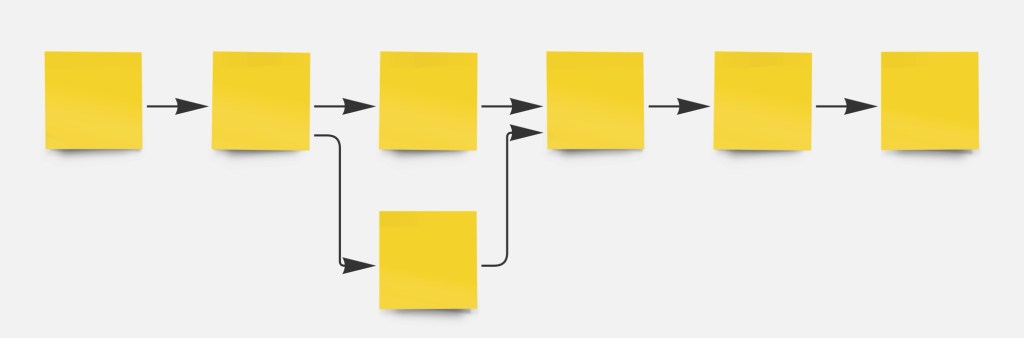
Pretty straightforward, simple and yet very effective in exposing all kinds of insights.
Recently, I had an opportunity to facilitate another value stream mapping workshop.
This time, in the spirit of always re-learning the basics to uncover more, I used it as an opportunity to dive deeper into the theory behind the practice. I had experienced the practice first-hand and was now ready uncover more insights and benefits by understanding the explanation behind the experience.
I cracked open one of the most authoritative books on the topic: “Value Stream Mapping: How to Visualize Work and Align Leadership for Organizational Transformation” by Karen Martin and Mike Osterling.
From the openning two sentences of the “Introduction”, I knew I was about to take my cursory knowledge of value stream mapping to a whole different level.
“We view value stream thinking as a fundamental mindset for business success. Without it, organizations fail to develop customer-centric processes and fail to organize in a way that best serves the very reason they exist.”
Karen Martin & Mike Osterling
I was ready to turn the old pieces of coloured glass in the value stream mapping kaleidoscope to see what other patterns emerge.
A single bladed practice focused on creating a value stream map was about to become a Swiss Army knife.
The book highlights six benefits of value stream mapping. A perfect way for me summarize my ascent from cursory level value stream mapping to next level value stream thinking.
Next Level Value Stream Mapping Benefits
- A visual unification tool
- It’s about visualizing invisible knowledge work
- It’s a powerful discovery and organization design tool
- The value stream mapping process is more valuable than the resulting value stream map
- It visualizes not only the flow of work but also the flow of information and timelines
- Connection to the Customer
- It sees “value” through the eyes of the customer
- It’s creates a foundation for customer centricity
- Holistic systems thinking methodology
- It focuses on global optimization vs. local / sub optimization
- It highlights dependencies
- It is a team sport that builds bridges spanning the organization vertically and horizontally
- A simplification tool
- It leans out the value stream and eliminates unnecessary waste
- A practical means to drive continuous improvement
- It leverages the power of PDSA/PDCA cycles or experiments
- It uses metrics like Lead Time, Process Time, Flow Efficiency and % Complete & Accurate to gauge improvement
- Effective means and aid for on-boarding new hires
- It visualizes and contextualizes where people fit in the organization
- It contributes to everyone’s sense of belonging
Thinking about the idea of value stream mapping in this way opens a door to a world of new possibilities. Next level value stream thinking lights the way from incremental to transformational improvements.


 Next Chapter Consulting